...OH, ONE MORE THING - PLEASE BOOKMARK US & VISIT DAILY!
Wade Keller, Torch editor The Torch covered UFC in its infancy, equating it to a rebirth of "real pro wrestling." The historical similarities were remarkable, yet the differences were vital to its potential for success. The following is our full page Pro Wrestling Torch Yearbook 1994 article covering UFC's first year of existence, written by Torch editor Wade Keller. It was written at a time where people weren't yet sure that the Gracie family wasn't fixing fights in Royce's favor, something that is not even considered an issue in retrospect.
ORIGINAL HEADLINE 1994 Top Ten PWTorch Stories (#7) UFC EVENTS SUCCEED
Wrestling/martial arts hybrid finds audience
Originally published in 1994 Pro Wrestling Torch Yearbook
Professional wrestling became a worked athletic stage show because real stuff was much too boring. When two wrestlers of equal skill level got into the ring against each other, they would wrestle for more than an hour, sometimes not relinquishing a hold for that entire period. Some fans were intrigued by the human chess match, but most other were bored with it.
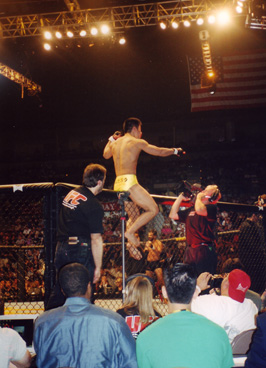
(Photo by Wade Keller, Torch editor)
Wrestling promoters, who evolved from running carnival tough-man challenges, saw that there was bigger money in some match-ups than others and bigger money with some match styles than others. Therefore in the 1910s, if not a few years sooner, main event wrestling matches were scripted in the sense that outcomes were predetermined in order to produce the best rematches down the line.
In the 1937 book "Fall Guys," Marcus Griffin wrote about the dominant wrestler of that era, Frank Gotch. "Gotch, according to old timers, was a supreme bluffer who went his merry successful bonebreaking way because he did ‘business' with the more capable bonecrushers whom he met and dominated the lesser lights through a fiendish delight in breaking bones and maiming less fortunate and skilled adversaries."
There was doubt in those early years of organized professional worked wrestling whether Gotch could have defeated Joe Stecher, Ed "Strangler" Lewis, Stanislaus Zbyszko, Joe "Toots" Mondt, and others of his era and future eras.
That brings us full circle, perhaps, to the Ultimate Fight Championships. Is Royce Gracie the Frank Gotch of his era? Is he a legitimately tough fighter with enough grappling and martial arts skills to defeat most opponents, but then "does business" (i.e. plans finishes) with those whom he might lose to?
If the gravy train is lucrative enough, there will be a long line of credential-filled opponents willing to "do the job" for Gracie for a big payoff. That's how it worked in the olden days, and that's how it might just be working now.
The Ultimate Fight Championship tournaments (UFC) debuted on pay-per-view in 1993. They grew in popularity and publicity throughout 1994, ending 1994 as a definite competitor to the WWF and WCW. UFC in-house statistics reported a 40 percent crossover rate of their pay-per-view customers with wrestling fans.
Some would argue that UFC, real or not, is professional wrestling also. After all, UFC's rules are basically that of professional wrestling cage matches - there are basically no rules and the only way to win is to cause your opponent to submit or knock them out. The techniques used during UFC tournaments are similar to what pro wrestling would be like if it were real. It certainly resembles the UWFI and Pancrase in Japan - two professional shoot wrestling groups - rather than boxing, full-contact karate, and kickboxing.
In fact, those who know how to grapple on the mat rather than those who are only adept at striking on their feet tend to dominate the tournaments, most notably Royce Gracie. UFC is nothing more than pro wrestling gone full circle, back to its roots in the early 1900s.
The lingering question is whether UFC's matches are works. What isn't lingering is whether UFC has been a success. Pay-per-view industry trade journals estimate that UFC4 drew a buyrate around 1.0, not far off in overall buys from the so-called dream match of Hulk Hogan vs. Ric Flair. All three UFC events in 1994 averaged better buyrates on pay-per-view than WCW's eight events and only slightly below the WWF's five-event average.
Another element that makes UFC fit into the category of pro wrestling is that it features several athletes who are also pro wrestlers. The main event opponent for the phenom Gracie, Ken Wayne Shamrock, is a former pro wrestler in the U.S. who now concentrates on shoot-style wrestling with Pancrase in Japan. Dan Severn is a veteran independent pro wrestler in the U.S. who wrestles regularly in Japan for the shoot-style UWFI and on U.S. indie shows.
While the UWFI is clearly not "real fighting" in that the finishes are predetermined, there is more mystery over the Pancrase group in Japan and the UFC tournaments in the U.S.
Coming out of UFC3, there were many who were skeptical of the realism. Many fighters threw roundhouse punches that barely grazed their opponents rather than straight punches with a better chance of striking on target. Other changes in the tournament format looked like behind-the-scenes maneuvering but turned out to be merely disorganized growing pains.
UFC4 ended no better. The show went off the air before the conclusion of the main event in around half of all cable homes because the match went longer than the allotted satellite time. That made the match seem real, but on the other hand some were skeptical of the way the finale ended with Severn giving up to Gracie suddenly, as if to not go past a short extension they received on satellite in the other half of the homes.
Real or not, UFC is battling the image of being "too violent." Despite a mutual respect that appears to exist between most fighters not to try to permanently hurt or maim each other, the lack of rules and selected highlights used to sell the shows early on made UFC look like human cockfights. Unlike pro wrestling in the early 1900s where strikes with fists were illegal, UFC allows such blows. As a result, be it in a New York media blitz, Details magazine, or syndicated TV talk shows, all have taken their shots at the UFC's potential brutality.
If UFC is to continue building momentum, they'll have to stand the scrutiny of whether its bouts are predetermined and whether its too violent to deserve acceptance in mainstream America.
Either way, for as long as it exists and as long as it remains at its current success level or grows, it will provide a legitimate alternative to the WWF and WCW events. Its success could influence the style of the WWF and WCW, perhaps sending them in the other direction to a more high-flying, less violent lucha libre style or to directly competing with UFC by providing a more realism-based style.
UFC has already had an impact on pro wrestling and throughout 1995, U.S. promoters will closely watch and react to this unexpected new pay-per-view competition.
DON'T GO YET... WE SUGGEST THESE MMATORCH ARTICLES, TOO!
Jamie Penick, editor-in-chief
(mmatorcheditor@gmail.com)
STAFF COLUMNISTS: Shawn Ennis - Jason Amadi
Frank Hyden - Rich Hansen
Chris Park - Matt Pelkey
Interested in joining MMATorch's writing team? Send idea for a theme to your column (for Specialist section) or area of interest (i.e. TV Reporter) along with a sample of writing to mmatorch@gmail.com.