...OH, ONE MORE THING - PLEASE BOOKMARK US & VISIT DAILY!
By Anwar Perez, MMATorch Columnist
For the month of February, we will be looking at important African-Americans during Black History month in MMA. Some were champions, others pioneers for the sport outside of the cage. This week, we take a look at Maurice Smith, who is possibly the first African-American champion in regulated MMA. Special thanks to fellow Torch columnist Bob Teal for clearing up a few facts for this piece.
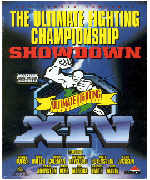
Maurice Smith was making his UFC debut at UFC 14: Showdown, in a title fight against then heavyweight kingpin, Mark Coleman. Smith was coming into the fight with a 4-7 MMA record from fighting in RINGS and Pancrase. He was a kick-boxing champion in his career before MMA, and after a stint in K-1, decided to try MMA.
Even with a tremendous striking ability, Smith entered the fight as a huge underdog, as Coleman was the heavy favorite going into the fight. Mark Coleman was undefeated in all his appearances in the Octagon, and it seemed that streak was not going to end to a fighter who had such a sub-par record.
At the beginning of the fight, all you could see were signs for Coleman and huge crowd support for the champ. As the fight started, it was going all Coleman's way. Smith had been taken down and Coleman was doing what he does best, and that's the art of ground and pound.
This was Mark Coleman in his prime and there was no one better than him at this sort of thing, but for all the power he put into his strikes from the top, Coleman could not take Smith out. Smith was patient on the bottom, and able to cover-up well enough that ref Big John McCarthy didn't put a stop to it.
This lasted for a few minutes and Coleman could not seal the deal on Smith. Then you could see it. Coleman had gassed himself. When they were back on their feet, Coleman could not stop from taking deep breaths and dropping his hands. Smith was still relatively breathing normally, but many were not sure if he had sustained too much damage to change the course of the fight or sway the judges to his side if the fight went to a decision.
Smith started connecting on some combinations and attacking Coleman on the feet. His leg kicks were wearing Coleman down and did the most damage by taking away Coleman's most-used weapon, the takedown. Anytime that Coleman shot for the takedown, he missed wildly and couldn't spring forward the way he could if he had his legs.
This continued into the sudden death round, and Smith kept picking away at Coleman's legs. No one had defeated Coleman in the cage until that night. When the fight went to the judge's decision, the bout and the championship was awarded to Smith via unanimous decision.
This was also the turning of the tide, as many saw that grappling (wrestling or jiu-jitsu) was the way of the fighter and how you won fights. Instead of a brawler like Tank Abbot, you had a striker in Maurice Smith that picked his shots carefully and was able to not just use his hands, but also his legs in stopping Coleman. That was a skill-set that had not yet been seen in MMA, as most of the dominant fighters at the time were grapplers of some sort.
This was a high mark for a fighter who walked into that fight and had many scratching their heads as to why someone with a record like his had any business fighting the top dog in MMA at the time, Mark Coleman. Maurice Smith won and possibly is able to lay claim as being the first African-American championship belt-holder in MMA. There are many who would argue that he may have not been, but in a time when MMA was black-balled by PPV, the government, and most people outside of the hardcore fans, there were not many organizations in the US, let alone championship belts.
Smith would successfully defend against Tank Abbot, but lose to Randy Couture in a close decision. He fought for the UFC a few more times and also had a stint in Pride, but retired in 2000, only to come back in 2007.
Not only did he bring a new skill-set into the fight game, he also became a trailblazer that night and showed that not only Brazilians or Caucasian fighters could become world champions.
Part two will deal with the contributions that NFL Hall of Fame player Jim Brown provided MMA.
DON'T GO YET... WE SUGGEST THESE MMATORCH ARTICLES, TOO!
Jamie Penick, editor-in-chief
(mmatorcheditor@gmail.com)
STAFF COLUMNISTS: Shawn Ennis - Jason Amadi
Frank Hyden - Rich Hansen
Chris Park - Matt Pelkey
Interested in joining MMATorch's writing team? Send idea for a theme to your column (for Specialist section) or area of interest (i.e. TV Reporter) along with a sample of writing to mmatorch@gmail.com.